How Much Income Do You Need to Afford Student Loan Payments?
Learn how much the average household needs to live financially balanced with student debt.


Key Takeaways
- The average student borrower has a monthly payment of $536. That’s a big chunk of money, no matter what your paycheck looks like.
- According to the 50-30-20 rule, your household would need to bring in $166k (before tax) to comfortably make student loan payments while balancing other needs.
- Struggling to repay student loans isn’t a budgeting issue. The gap between the average income and the average student debt burden is massive and growing.
- Luckily, there are ways to decrease your monthly payments like changing your loan terms, paying a little extra when you can, and seeking outside support through crowdfunding and employer benefits.
Ever wondered how much income you’d need to comfortably cover your student loan payments?
Using the 50-30-20 rule and the latest Consumer Expenditures report, we calculated what it would take for the average household to afford the average student loan payment – and it’s a lot more than you’d think.
The income needed to comfortably pay off student loans
How we calculated this: We took all the basic needs categories from the Consumer Expenditures report and added in student loan payments. This gave us the average cost of essential expenses in the US, which represents the 50% “needs” portion of the 50-30-20 rule.
The 50-30-20 rule suggests post-tax income be split three ways:
- 50% toward needs (housing, food, utilities, and minimum debt payments)
- 30% toward wants (travel, experiences, and discretionary spending)
- 20% toward savings (retirement, investments, and emergency funds)
To calculate the income required to comfortably pay off student loans, we started with understanding how much basic needs cost.
According to the Consumer Expenditures report, the average two-person household spends $57,503 on basic needs annually:
- Food: $10,169
- Healthcare: $6,197
- Housing: $26,266
- Transportation: $13,318
- Personal hygiene needs: $978
- Personal insurance: $575
Add in the average student loan payment of $536 over the course of a year, and you’re looking at non-negotiable bills of $63,835. Double that number for the ideal take-home pay and account for income tax (30%), and you get a pre-tax income of over $166k.
Here’s the math:
$536 monthly loan payments x 12 months = $6,432 in annual loan payments
$6,432 in annual loan payments + $57,503 in other basic needs = $63,835 in total basic needs
$63,835 in total basic needs x 2 = $127,870 in ideal take-home pay
$127,870 in ideal take-home pay + 30% income tax = $166,231 in pre-tax income
$166k. That’s roughly how much a household needs to make to comfortably pay student loans while still saving for the future and enjoying day-to-day life.
And if there’s two borrowers at home? That number climbs to around $180k (yikes).
Want to know much you personally need?
You can run a quick version of this calculation yourself:
- Add up your monthly needs (housing, food, transportation, healthcare).
- Add in your monthly debt payments (student loans, credit cards, car loans).
- Multiply that number by 12.
- Double it to get the ideal take-home income under the 50-30-20 rule.
The result gives you an estimate of the take-home income needed to comfortably balance your finances. If you want to convert that to pre-tax salary, simply multiply by 1.3.
Student debt isn’t a simple budgeting problem
If these numbers feel unrealistic, that’s because for many, they are. And the problem isn’t poor budgeting. Student borrowers are facing a massive gap between income and debt obligations.
According to the Consumer Expenditures report, the average two-person household earns about $104k before tax, which translates to roughly $72k after tax. That’s significantly less than the $166k needed to comfortably balance student loan payments alongside everyday expenses.
When the income needed to comfortably balance a budget is tens of thousands of dollars higher than what the average household earns, borrowers are forced to sacrifice and struggle.
For many households, student loan payments compete directly with essential expenses like housing, transportation, and healthcare. As a result, borrowers often extend repayment timelines, delay saving for retirement, or cut back on everyday necessities just to stay afloat.
While larger, structural changes are needed – more affordable education, simpler pathways to forgiveness, and policies like NYS Bill 4202A – there are still ways borrowers can reduce their monthly debt burden today.
3 Ways to Decrease Your Student Loan Payments
1. Change your repayment terms
To truly lower your mandatory payment, you may need to change your repayment plan or refinance your loan. Both options can reduce what you owe each month, though they may extend your repayment timeline and increase total interest paid over time.
2. Pay extra when you can
Any extra money applied to your loan balance reduces what you owe in the long run. Even small additional payments toward the principal can significantly reduce the interest you’ll accrue over time, and may even shorten your repayment timeline.
3. Seek outside support
Your paycheck shouldn’t be your only source of support.
Some borrowers ask for student loan contributions instead of traditional gifts during birthdays, holidays, and other major life events. Crowdfunding your student loans gives family and friends an easy way to contribute where it matters most.

All yours in just a few taps
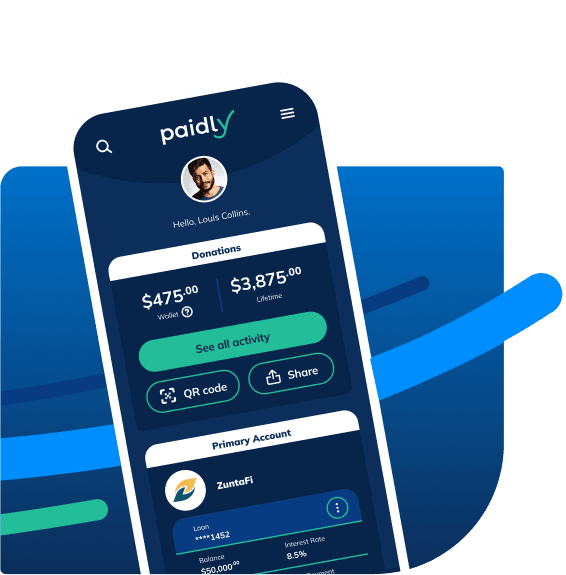
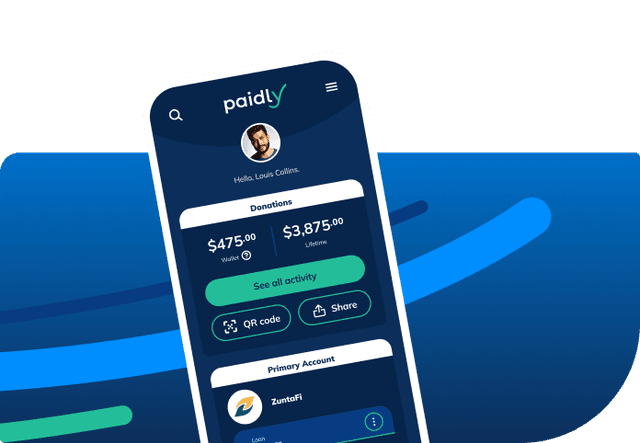
Gain financial awareness and take control of your debt, savings, and donations. Paidly is a convenient, connected way to get ahead with no pay-to-download or hidden fees.


Your employer could also be helping with your loans. Ask your HR department if they offer student loan assistance through direct contributions or payroll deductions. It’s tax-free for employers when under a Section 127 plan, which puts more of that money directly toward your loan.
Want to see how soon you could be debt-free? Try our Student Loan Payoff Calculator.
You can be debt-free without the “right” income
For many borrowers, the “right” income to comfortably manage student debt may feel out of reach, but freedom from debt is not.
The math shows a real gap between income and debt obligations, but progress doesn’t require perfect circumstances. Small, consistent actions like adjusting your loan, paying a little extra, or tapping into outside support can dramatically change your long-term outcome.
Student debt shouldn’t be a burden you carry alone. Whether through employer benefits, community support, or creative repayment strategies, there are more tools available today than ever before to get you to a debt-free future.

Samantha Park
Samantha Park is a writer with a background in public service work. She earned a M.S. in Professional Writing from Towson University where she focused on writing for the private and public sectors, and has previously graduated with an A.A. in Psychology from Anne Arundel Community College and a B.A. in Sociology from the University of Maryland College Park. Samantha has worked within and alongside the public sector for over a decade and cares deeply about empowering marginalized youth, expanding access to opportunity through education, and increasing community involvement.
Stay Ahead of the Curve
Get the latest insights on student loan repayment, 529 contributions, and maximizing employer benefits delivered to your inbox.
The information provided is of a general nature and an educational resource. It is not intended to provide advice or address the situation of any particular individual or entity. Any recipient shall be responsible for the use to which it puts this document. Paidly shall have no liability for the information provided. While care has been taken to produce this document, Paidly does not warrant, represent or guarantee the completeness, accuracy, adequacy, or fitness with respect to the information contained in this document. The information provided does not reflect new circumstances, or additional regulatory and legal changes. The issues addressed may have legal, financial, and health implications, and we recommend you speak to your legal, financial, and health advisors before acting on any of the information provided.
You may also like
Why I Started Paidly
We set out to stop student debt from making life decisions for employees.


The HR Guide to Using Your Entire Education Budget
Your education budget can do a lot more than just pay for tuition. Learn how adding student loan repayment can expand your benefits without expanding your budget.
Education Benefits You Should Know About
Education benefits like 529 savings, tuition reimbursement, and student loan repayment can help you reduce education costs during every stage of your career.