
Why I Started Paidly
We set out to stop student debt from making life decisions for employees.

Key Takeaways
- We saw talented employees leaving jobs they loved for better-paying opportunities so they could deal with their student debt.
- Traditional benefits weren’t providing the support employees need most. A 401(k) match means little to someone who can't afford to contribute.
- Student loan repayment benefits turned out to be a powerful retention tool. We found shouldering some of the burden was rewarded with years of loyalty.
- We built Paidly to make student loan assistance easier to offer. Employers of all sizes can support their skilled workforce without overburdening HR.
The Paidly Story is simple: we wanted to stop losing good people to student debt.
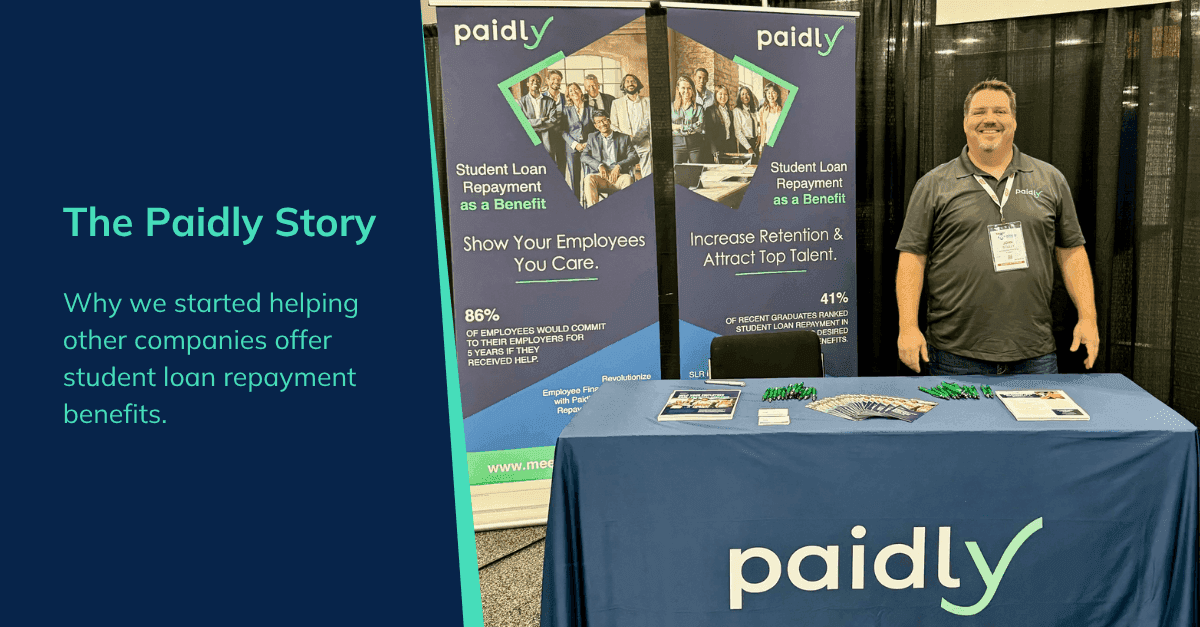
Years ago, I ran a technology company that built out software for companies like Chime Bank, Bestow, and Earnest. We were small and scrappy and very proud of the team we'd built. We couldn't outspend bigger competition, so instead we found talented, hungry people early in their careers, trained them, and watched them grow.
Much too often, we also watched them leave.
When asked what would make them stay, the answer was a bigger 401(k) match. So we raised our match and saw that almost nobody used it.
That’s because to get a match, you have to contribute first, and our people didn't have the extra money to set aside. Their paychecks were going to student loans before anything else. One of our employees couldn't buy the car he needed. Another couldn't afford to move into a two-bedroom apartment. Yet another told me he couldn't afford to get married.
We needed to stop student debt from making decisions for our employees
None of our employees lacked ambition – they were simply all stuck under student debt. Too often, that meant looking for a higher salary elsewhere, even when they didn’t want to leave their job with us.
We’d been offering retirement savings to people still struggling to get through their twenties. So instead, we started helping them pay down their student loans.
Through a student loan repayment benefit, one of our employees paid off his student loan three years early. And he never left. Johnny is still with me today at Paidly.
That was the moment it really clicked. We hadn't handed Johnny a raise that would disappear into rent and groceries and day-to-day life. We’d lightened the burden weighing on him most, and he answered with years of loyalty. For a small business (heck, for any business) that’s a return we can’t replicate any other way.
We’d always said our employees are our greatest resource and Johnny showed us what that truly means in practice.
Create an informed employee retention strategy
See what your return on investment could look like when offering a Student Loan Repayment Benefit
See your return
The solution was surprisingly simple: Section 127
We weren't the only ones losing great people to student debt. Every business owner we talked to was facing the same problem we had: student debt was making decisions for their employees, forcing them to put off cars, apartments, weddings, children, and retirement.
The tools to address the student debt issue already exist. Section 127 of the tax code lets employers contribute up to $5,250 a year toward an employee's student loans, tax-free for both sides.
Any employer can offer the benefit, but most don't. Why? Because running student loan assistance on your own is a major headache. You have to track every loan, pay every servicer, and keep it all compliant – we learned that firsthand.
So we built the tool we wish we'd had, and that was the beginning of Paidly.
Student loan repayment is the benefit for a modern workforce
My co-founders and I started Paidly around the simple idea that any employer should be able to do for their people what we did for Johnny. Not only that, but anyone should be able to set up the benefit in days rather than quarters. With Paidly, there's no need for HRIS integration or a new department to manage the benefit. Contributions go straight to loan servicers or 529 plans, and employees feel the impact right away.
Today, our clients see employee retention rates at 92%. That's Johnny's story, repeated across dozens of workplaces.
Student loan repayment assistance is the new necessity. In the 1940s, employer healthcare went from a perk to an expectation in a single generation. The 401(k) did the same thing a few decades later. I believe student loan repayment is next. More than 40 million Americans carry student debt, and they're choosing employers based on who helps them get out from under it.
Taking care of your people is the best investment a business can make. Big companies figured that out a long time ago. Paidly exists so everyone else can too.
Ready to get started?


John Scully, CEO
John Scully is a seasoned executive leader with a strong background in business operations and technology. As Co-Founder of Paidly Student Loan Benefits, he empowers employers to enhance talent recruitment and retention through a cloud-based platform that allows tax-free student loan payments. With experience in industries like healthcare and fintech, John has held leadership positions at companies such as Sharp Notions and the University of Rochester Medical Center. Holding an MBA from the University of Rochester and a B.S. from Excelsior College, John is dedicated to helping organizations and individuals navigate the complexities of Fintech, especially student loan payments.
Stay Ahead of the Curve
Get the latest insights on student loan repayment, 529 contributions, and maximizing employer benefits delivered to your inbox.
The information provided is of a general nature and an educational resource. It is not intended to provide advice or address the situation of any particular individual or entity. Any recipient shall be responsible for the use to which it puts this document. Paidly shall have no liability for the information provided. While care has been taken to produce this document, Paidly does not warrant, represent or guarantee the completeness, accuracy, adequacy, or fitness with respect to the information contained in this document. The information provided does not reflect new circumstances, or additional regulatory and legal changes. The issues addressed may have legal, financial, and health implications, and we recommend you speak to your legal, financial, and health advisors before acting on any of the information provided.
You may also like

The HR Guide to Using Your Entire Education Budget
Your education budget can do a lot more than just pay for tuition. Learn how adding student loan repayment can expand your benefits without expanding your budget.


Education Benefits You Should Know About
Education benefits like 529 savings, tuition reimbursement, and student loan repayment can help you reduce education costs during every stage of your career.

ABLE Accounts and 529 Plans: A Flexible Savings Strategy
Learn how 529 plans and ABLE accounts work together to make your savings even more supportive.
