Breaking the Cycle: How Modern Benefits Can Support Generational Wealth Building
Learn how student loan repayment and 529 benefits help employees move from debt-burdened to wealth-building.


Key Takeaways
- Income does not equal wealth. High salaries can’t create financial security when student loan debt delays access to homeownership, retirement savings, and investing – the real drivers of long-term wealth.
- Student debt creates a permanent head start for some and a long delay for others. Employees without debt begin building equity immediately, while borrowers can lose 10–20 years of wealth-building time.
- Employer benefits can change the repayment timeline. Student loan repayment benefits help employees enter housing and investment markets years sooner and can be tax-free when under a Section 127 plan.
- 529 contributions break the cycle of debt. Supporting college savings prevents education debt from repeating across generations, giving employees’ families a true head start.
The American Dream is often described as a straightforward path: obtain higher education, build a stable career, and use that income to build a life better than the one you inherited. For many families, the path has worked. For others, that dream has always been harder to access.
Today, rising education costs add another layer of complexity. The entry ticket to the professional class (a college degree) has become so expensive that the debt required to obtain it now cancels out the wealth-building potential of the career itself. By the time many employees pay off their education, they’ve missed two decades of crucial wealth-building years.
Employers are uniquely positioned to help address this imbalance. By offering student loan repayment and 529 college savings benefits, companies can support employees in moving from debt management toward long-term financial stability.
Income Does Not Equal Wealth
The greatest misconception in modern compensation is that a high salary automatically leads to financial security.
Wealth grows through compounding assets like homes, stocks, and business equity. Student loan debt acts as a wealth inhibitor, delaying access to those assets. Every dollar funneled toward interest on a loan is a dollar that cannot be used to buy a home or invest in the market, which creates a systemic divide:
- The Head-Start Group. Employees who enter the workforce with no debt (often due to family assistance) and can immediately begin building equity.
- The Debt-Burdened Group. Employees who must self-finance their education and spend the first 10–20 years of their careers paying it off.
By the time the second group clears their debt, the first group has a twenty-year lead on compound interest – a gap that’s almost impossible to close through salary alone. These differences are not about effort or talent but rather reflect unequal access to resources.
Direct employer intervention via loan repayment is the only way to sync these timelines and allow employees to participate in the economy at the same rates.
Increasing the Velocity of Money
Providing student loan assistance benefits derails the cycle of debt. When companies use tax-advantaged programs like a Section 127 plan to help pay down an employee’s student loans, they reduce the balance and boost that employee’s financial velocity.
Reducing debt three or five years earlier allows employees to enter the housing and investment markets years sooner than they otherwise would have. Even modest annual contributions become wealth multipliers by unlocking additional time for compounding.
Breaking the Cycle of Education Debt
Student loan repayment addresses existing debt, but 529 savings contributions prevent the cycle from repeating.
The generational wealth gap widens when parents are so burdened by their own student loans that they cannot save for their children’s education. Not having savings means the next generation must also borrow, creating a permanent cycle of interest payments that drain wealth away from families and make them reliant on loans in order to access opportunity.
Employer contributions to 529 plans break the cycle of debt. They ensure that the employee's children get a head-start, rather than starting debt-burdened.
The Corporate Role in a Healthy Economy
A healthy economy depends on a workforce that can move beyond financial survival and participate fully in long-term growth. When a large portion of the workforce is sidelined by negative net worth, the entire economic ecosystem suffers from reduced homeownership rates and lower consumer stability.
The companies that recognize debt as a structural challenge and take steps to reduce its impacts will be the ones who rebuild the path to the American Dream for the current and next generation of workers.
To integrate debt relief into your benefits package, Talk to an Expert or get started with Paidly.

John Scully, CEO
John Scully is a seasoned executive leader with a strong background in business operations and technology. As Co-Founder of Paidly Student Loan Benefits, he empowers employers to enhance talent recruitment and retention through a cloud-based platform that allows tax-free student loan payments. With experience in industries like healthcare and fintech, John has held leadership positions at companies such as Sharp Notions and the University of Rochester Medical Center. Holding an MBA from the University of Rochester and a B.S. from Excelsior College, John is dedicated to helping organizations and individuals navigate the complexities of Fintech, especially student loan payments.
Stay Ahead of the Curve
Get the latest insights on student loan repayment, 529 contributions, and maximizing employer benefits delivered to your inbox.
The information provided is of a general nature and an educational resource. It is not intended to provide advice or address the situation of any particular individual or entity. Any recipient shall be responsible for the use to which it puts this document. Paidly shall have no liability for the information provided. While care has been taken to produce this document, Paidly does not warrant, represent or guarantee the completeness, accuracy, adequacy, or fitness with respect to the information contained in this document. The information provided does not reflect new circumstances, or additional regulatory and legal changes. The issues addressed may have legal, financial, and health implications, and we recommend you speak to your legal, financial, and health advisors before acting on any of the information provided.
You may also like
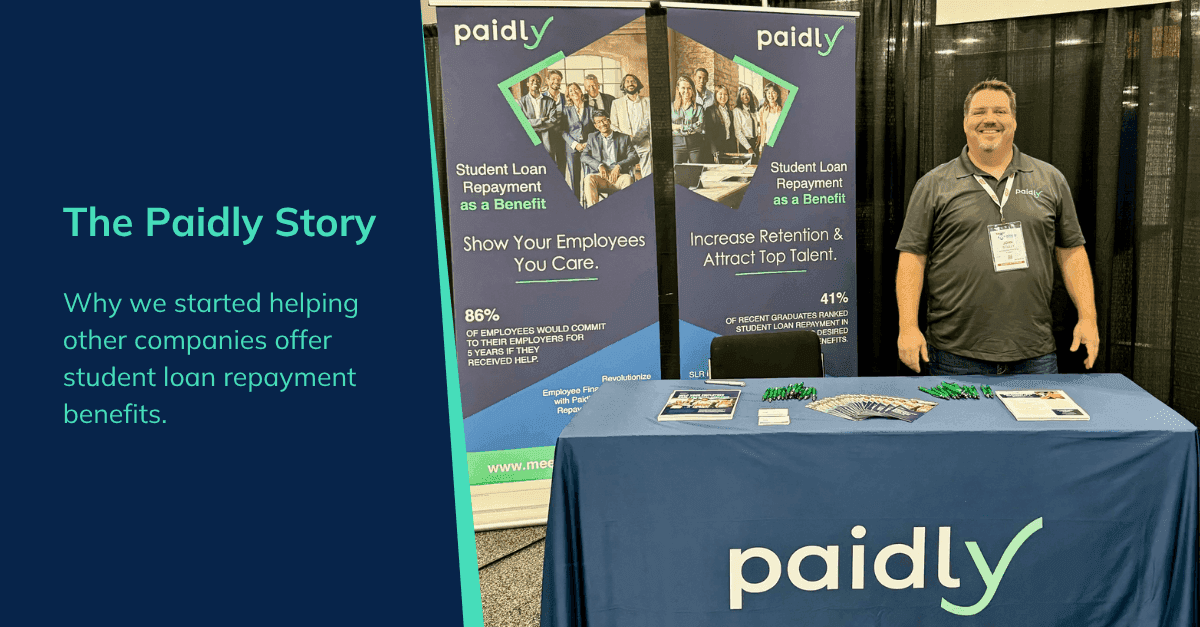
Why I Started Paidly
We set out to stop student debt from making life decisions for employees.


The HR Guide to Using Your Entire Education Budget
Your education budget can do a lot more than just pay for tuition. Learn how adding student loan repayment can expand your benefits without expanding your budget.
Education Benefits You Should Know About
Education benefits like 529 savings, tuition reimbursement, and student loan repayment can help you reduce education costs during every stage of your career.