How the One Big Beautiful Bill Affects Student Borrowers
OBBBA is reshaping federal student loans through reduced repayment plans, tighter hardship protections, and new borrowing caps. Here’s what you need to know.

Key Takeaways
- Federal student loan safety nets are shrinking. The elimination of many IDR options, combined with reduced deferment and forbearance allowances, means many borrowers will face higher monthly payments and fewer protections during times of financial hardship.
- Graduate students and parents will have fewer ways to finance education. New caps on graduate borrowing and Parent PLUS loans could make advanced degrees more difficult to afford, particularly in fields like medicine, law, and education where program costs often exceed federal limits.
- Employer support is more important than ever. The permanent extension of tax-free employer student loan repayment assistance gives organizations a real way to help employees manage debt and provides borrowers with an increasingly valuable source of support as federal options narrow.
This article was originally posted to Paidly CEO John Scully’s LinkedIn on July 10th, 2025.
On July 4th, 2025, Trump’s massive bill, the “One Big Beautiful Bill Act” (OBBBA), became law, sparking huge changes for student loan borrowers.
Here are the four major ways student borrowers are affected and what you can do about it.
How the Big Beautiful Bill Affects Student Borrowers
1. Reduced repayment options for all federal borrowers
One of the biggest changes is the narrowing of repayment plan options.
The bill eliminated several popular income-driven repayment plans: Saving on A Valuable Education (SAVE), Income Contingent Repayment (ICR), and Pay As You Earn (PAYE).
Borrowers currently on these plans have until July 1st, 2028, to change to one of two options: a standard repayment plan or the Repayment Assistance Plan (RAP). Beginning July 1st, 2026, new borrowers will only be given these two options:
- The new standard plan uses the amount borrowed to determine monthly payments and the length of the repayment term.
- RAP uses income to determine monthly payments, with all borrowers needing to make 360 on-time payments (30 years) before receiving forgiveness. Borrowers on the plan will pay 1-10% of their income in monthly payments depending on their income bracket, with a minimum monthly payment of $10.
Many experts warn that the limited remaining repayment options will raise monthly payments for most borrowers.
2. Reduced access to deferment and forbearance for future borrowers
Another major change for borrowers is access to deferment and forbearance for loans taken out on or after July 1st, 2027.
The bill eliminated deferment due to unemployment or economic hardship. This means those with limited incomes will still be required to make their monthly payments, even if unemployed.
This could be especially difficult for struggling borrowers since the allowance for forbearance has been shortened: borrowers will only be allowed 9 months of forbearance (previously 12 months) in a 24-month period.
Combined, future borrowers will have vastly reduced access to financial safety nets, forcing them into delinquency or default if they cannot afford to keep up with their payments.
3. Reduced federal loan options for graduate students, professional students, and parents
The bill also eliminated new Grad PLUS loans and greatly limits the amount graduate students and professional students can borrow starting on July 1st, 2026:
- Graduate student borrowing is capped at $100k.
- Law and medical student borrowing is capped at $200k.
With the cost of graduate programs often far exceeding these limits, many graduate and professional students will no longer be able to afford their education.
Parent PLUS loans also have a cap: $65k per student. In addition to this limit, Parent PLUS loans will not be eligible for income-based repayment plans or loan forgiveness starting on July 1st, 2026.
4. Permanent tax break for employer-sponsored contributions
Perhaps the one bright side for borrowers is the extension of tax incentives for employer-sponsored student loan repayment contributions (previously set to expire at the end of 2025).
The tax break is now permanent, a huge win for employers and student borrowers alike. Employers can pay up to $5,250 toward employee student loans, which could improve borrowers’ abilities to afford their new increased student loan payments.
The $5,250 limit per employee will be adjusted for inflation annually starting in 2027.
What You Can Do
Many experts agree: federal student borrowers will suffer under the reduced loan options, limited repayment plans, ineligibility for deferment, and shortened forbearance.
- Limited repayment options lead to higher monthly payments, worsening the financial situations of millions of borrowers and their families.
- Weakened deferment and forbearance mean borrowers will still have to make payments during times of hardship and unemployment.
- Capped borrowing for graduate students, professional students, and parents restricts access to education, especially for desperately needed fields like teaching, medicine, and law.
Though the Big Beautiful Bill has negative outcomes for many, student borrowers and those around them are not powerless. How you respond matters. Here’s what you can do in light of these changes:
If you’re a student borrower… Make sure you know which changes impact you and when they go into effect. Depending on your circumstances and ability to make payments, you may want to consider refinancing, crowdfunding, or talking to your employer about repayment assistance.
If you’re an employer… Consider starting or expanding your student loan assistance benefit. This is one crucial way you can support your staff and future employees as they’re impacted by the bill’s changes (plus, your contributions are tax-free).
If you know a student borrower… Ask if they’re crowdfunding their student loans and chip in if you can. Every bit counts when it comes to paying off student debt and making a contribution can take a big weight off their shoulders.
Learn how Paidly can help you start employer student loan assistance benefits or crowdfund student loans.
To read the One Big Beautiful Bill Act yourself, visit www.congress.gov/bill/119th-congress/house-bill/1/.

John Scully, CEO
John Scully is a seasoned executive leader with a strong background in business operations and technology. As Co-Founder of Paidly Student Loan Benefits, he empowers employers to enhance talent recruitment and retention through a cloud-based platform that allows tax-free student loan payments. With experience in industries like healthcare and fintech, John has held leadership positions at companies such as Sharp Notions and the University of Rochester Medical Center. Holding an MBA from the University of Rochester and a B.S. from Excelsior College, John is dedicated to helping organizations and individuals navigate the complexities of Fintech, especially student loan payments.
Stay Ahead of the Curve
Get the latest insights on student loan repayment, 529 contributions, and maximizing employer benefits delivered to your inbox.
The information provided is of a general nature and an educational resource. It is not intended to provide advice or address the situation of any particular individual or entity. Any recipient shall be responsible for the use to which it puts this document. Paidly shall have no liability for the information provided. While care has been taken to produce this document, Paidly does not warrant, represent or guarantee the completeness, accuracy, adequacy, or fitness with respect to the information contained in this document. The information provided does not reflect new circumstances, or additional regulatory and legal changes. The issues addressed may have legal, financial, and health implications, and we recommend you speak to your legal, financial, and health advisors before acting on any of the information provided.
You may also like
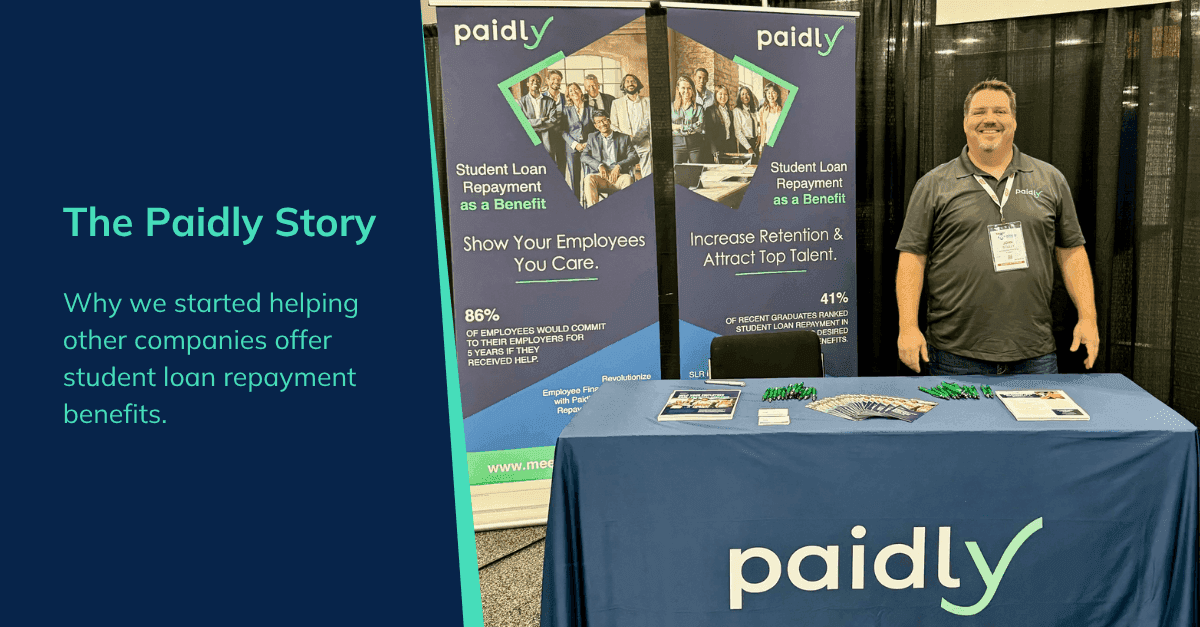
Why I Started Paidly
We set out to stop student debt from making life decisions for employees.


The HR Guide to Using Your Entire Education Budget
Your education budget can do a lot more than just pay for tuition. Learn how adding student loan repayment can expand your benefits without expanding your budget.
Education Benefits You Should Know About
Education benefits like 529 savings, tuition reimbursement, and student loan repayment can help you reduce education costs during every stage of your career.