
Boost Your PTO Buyback
Offering a PTO buyback helps your most dedicated employees, but being taxed as supplemental income decreases its value. Learn how you can offer tax-free or tax-advantaged PTO buybacks this year.


Key Takeaways
- Unused paid time off (PTO) has professional, mental, and financial consequences for employees. Employees who don’t take breaks are at risk of burnout.
- PTO buyback helps offset the negatives by giving employees the monetary value of their PTO in a lump sum.
- Traditional buybacks are taxed as supplemental income, reducing the value and impact of the buyback.
- Offer a tax-free or tax-advantaged buyback with Paidly. We can help you retain the value of unused PTO by distributing it as student loan or 529 savings contributions.
Every year, 30% of paid time off (PTO) goes unused, impacting employees professionally, mentally, and financially. Offering PTO buyback is one way employers can offset these losses.
Let's get into what PTO buyback is, why traditional PTO buybacks aren't as powerful as you'd think, and how offering PTO as a student loan or college savings contribution is a win for everyone involved.
Why does PTO go unused?
Employees choose to forgo taking PTO for many reasons. Some may feel unable to take time away from work due to their workload or workplace responsibilities. Others might find taking vacation is too costly, and employees with significant financial strain from their debt burdens – or those working to build up their savings – may skip a vacation in order to continue working toward their goals.

However, working for extended periods without breaks is a recipe for burnout, leading to impaired effectiveness, low satisfaction, and mental health issues. One way to improve employee morale is to offer PTO buyback.
What is PTO buyback?
PTO buyback is when the monetary value of unused PTO is paid to employees in a lump sum. This means that employees who choose not to take time off still receive the financial benefit of their PTO.
Essentially, PTO buyback helps offset the negatives of the unused benefit. Though it doesn’t give employees a vacation, it does help them feel appreciated and fosters financial peace of mind when burnout creeps in.
The disadvantage of traditional PTO buyback
Traditional PTO buybacks are typically given to employees as a lump sum in their end-of-year paychecks and are taxed as supplemental income. The 22% tax means your employees may receive less value than if they took the time off and were taxed at their regular pay rate.
Though offering PTO buyback is a perk in itself, distributing funds that get taxed at such a high rate means employees may feel they’re not truly receiving the fair amount. Luckily, there is an effective alternative: paying the PTO buyback as a student loan or 529 savings contribution.
PTO buyback as student loan or 529 savings contributions
Make your PTO buyback more powerful by offering the payout as a student loan payment or 529 savings contribution. Depending on your state and whether you have a section 127 plan, these options can reduce the tax imposed on the buyback, retaining (or even enhancing) the value.
Why it’s beneficial for employees
Not having supplemental income tax on their PTO buyback means employees get a higher payout. A lump sum of funds straight to their savings or loans brings your staff that much closer to their goals while maintaining the value of their PTO.
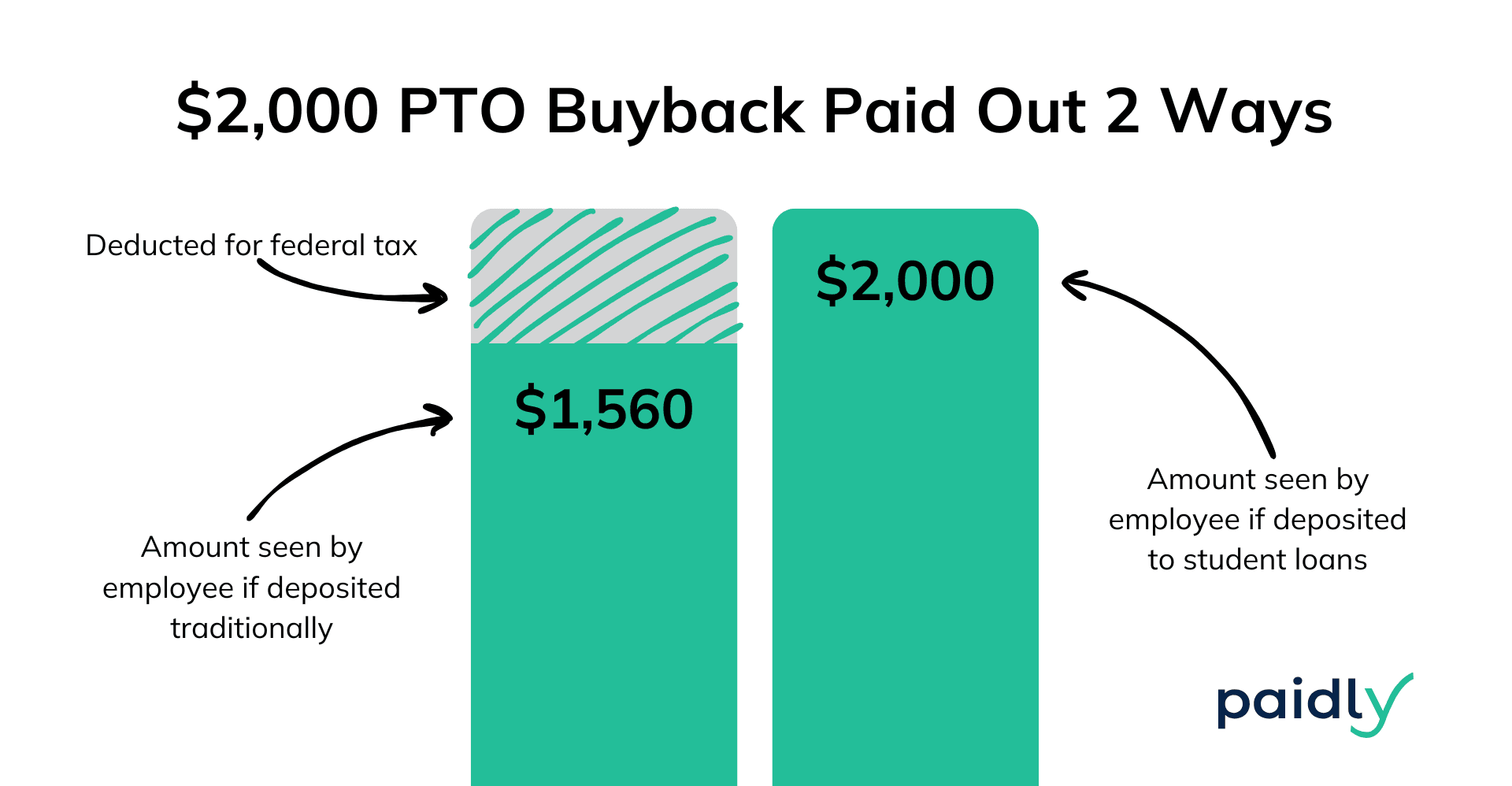
Say the value of an employee’s PTO is $2,000. If paid out as a traditional buyback, the employee will only get $1,560. If paid out as a contribution to student loans under a section 127 plan, the employee will get the entire $2,000.
Why it’s advantageous for employers
Why turn PTO into contributions? Under a section 127 plan, up to $5,250 in employee contributions to student loans are tax-free, making the buyback go further at no extra cost to you. Plus you’ll be making a significant dent in employee debt and reaping the benefits of supporting employee financial well-being.
Some states also offer tax advantages for employer contributions to 529 education savings plans. See if your state has tax incentives using our 529 state plan tool.
Offer tax-free or tax-advantaged PTO buybacks with Paidly
You can offer PTO buyback straight to student loans or education savings with Paidly.
Paidly lets you deposit funds directly through our easy-to-use platform. Manage both student loan assistance and 529 contribution benefits seamlessly – no need to log into multiple accounts. And Paidly handles employee financial information for you so your HR department has one less thing to worry about.

The buyback where everyone wins
PTO buyback is a way for employees to still receive the value of their unused PTO, offsetting burnout and giving them the boost they deserve. Everyone loses when employees have unused paid time off at the end of the year, but offering a buyback as a student loan payment or 529 savings contribution can make the time worked worth it.
Start offering PTO buybacks as student loan or 529 savings contributions with Paidly.

Samantha Park
Samantha Park is a writer with a background in public service work. She earned a M.S. in Professional Writing from Towson University where she focused on writing for the private and public sectors, and has previously graduated with an A.A. in Psychology from Anne Arundel Community College and a B.A. in Sociology from the University of Maryland College Park. Samantha has worked within and alongside the public sector for over a decade and cares deeply about empowering marginalized youth, expanding access to opportunity through education, and increasing community involvement.
Stay Ahead of the Curve
Get the latest insights on student loan repayment, 529 contributions, and maximizing employer benefits delivered to your inbox.
The information provided is of a general nature and an educational resource. It is not intended to provide advice or address the situation of any particular individual or entity. Any recipient shall be responsible for the use to which it puts this document. Paidly shall have no liability for the information provided. While care has been taken to produce this document, Paidly does not warrant, represent or guarantee the completeness, accuracy, adequacy, or fitness with respect to the information contained in this document. The information provided does not reflect new circumstances, or additional regulatory and legal changes. The issues addressed may have legal, financial, and health implications, and we recommend you speak to your legal, financial, and health advisors before acting on any of the information provided.
You may also like

Preparing for the Talent Storm: Student Loan Benefits for Recruitment & Retention
As skilled worker shortages loom, student loan repayment benefits give employers a practical way to attract early-career talent and retain valuable employees.
Why I Started Paidly
We set out to stop student debt from making life decisions for employees.


The HR Guide to Using Your Entire Education Budget
Your education budget can do a lot more than just pay for tuition. Learn how adding student loan repayment can expand your benefits without expanding your budget.