
Debt Without a Degree: The Student Loan Problem Nobody Talks About
Millions of Americans carry student debt without a degree. Discover why frontline workers are especially affected and how employers can use education benefits to help.


Key Takeaways
- Student debt doesn't require a degree. More than 16 million federal student loan borrowers have no diploma, and many are struggling to keep up with payments.
- Frontline workers are often overlooked. Employees in hourly and non-degree roles may carry student debt from a degree they never completed.
- Financial support makes all the difference. Student loan repayment and tuition assistance can help employees manage existing debt and finish the education they started.
- Education benefits are for everyone. Employers can contribute up to $5,250 annually toward student loans tax-free with Paidly.
An employer recently told me, "We run a call center. I'm not sure student loans are really an issue for our people."
I hear some version of this argument all the time. Employers whose jobs don’t require degrees often assume their employees haven’t pursued higher education. And though it's a fair assumption, it’s often wrong: 39% of Americans with student debt never finish their degrees.
That means many workers are carrying a financial burden completely hidden from those around them. It’s time we start talking about it.
16 million borrowers have no degree
Of the 42.3 million Americans currently holding federal student loans, more than 16 million have no diploma to show for it.
Degreeless borrowers struggle more than anyone. Six-figure balances mostly belong to people with graduate degrees; people who generally earn enough – or are on a trajectory to earn enough – to keep up with their debt. Borrowers who didn't graduate often owe less than $10k, but without a degree, they're three times more likely to default because they can’t keep up with the payments.
It makes sense: on minimum wage, a $100 monthly payment can break the budget. Balances grow as interest piles up, and it becomes very easy to default. In fact, more than 9.3 million federal borrowers were in default as of June 2026, up about 400k people in a single quarter.
Are you carrying debt without a degree?
If you’re a degreeless borrower, you have more options than you might think. If your loans are in default, rehabilitation programs can get them back in good standing. Additionally, your old credits may still count: many schools offer evening and online programs built for people finishing what they started. Ask HR whether your employer offers student loan assistance or tuition help.

All yours in just a few taps
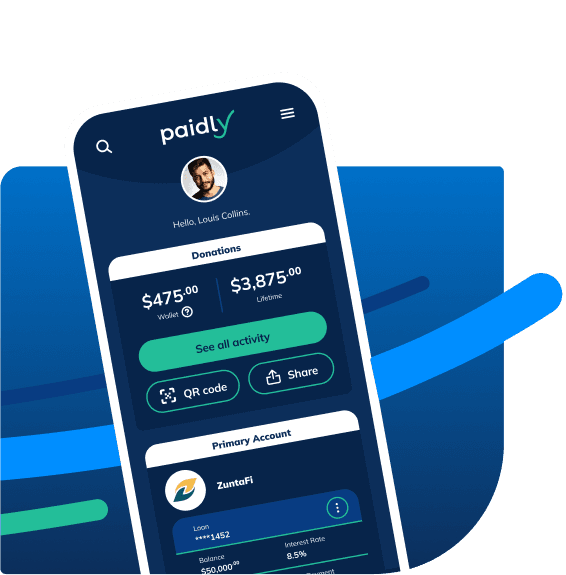
Gain financial awareness and take control of your debt, savings, and donations. Paidly is a convenient, connected way to get ahead with no pay-to-download or hidden fees.


Why it hits frontline workers hardest
Think about who works in a call center, a warehouse, a retail store, or a front desk. Plenty of them started college; maybe they did a year at community college, or two years at a state school before money got tight or life got in the way. In fact, community colleges are where most people who leave school without a degree last enrolled.
They don't have a degree on their resume, so they don't show up as "college-educated,” but student loans followed them regardless. According to the National Student Clearinghouse, 38 million working-age Americans have some college and no degree, and that number has been growing every year. Not all of them borrowed, but the ones who did are most likely to be behind on payments.
Money is often the reason students drop out of higher education in the first place. Around 40% of students abandon degrees due to financial stress, work demands, or tuition costs. That same pressure follows them to work every day. For employers, the burden of student debt shows up in turnover, missed shifts, and employees leaving for jobs that pay even a dollar more an hour.
What employers can do
Under Section 127 of the tax code, employers can contribute up to $5,250 a year per employee toward student loans, tax-free for both sides. That same benefit can also cover tuition, which means you could help your employees finally finish school. Many former students are closer to a degree than they think, and for someone who quit over a few thousand dollars, financial support from an employer can change everything.
Paidly makes it simple for employers to offer student loan repayment and 529 college savings as tax-free Section 127 benefits for every employee, including hourly and frontline teams. Talk to an Expert or get started today,
Ready to get started?


John Scully, CEO
John Scully is a seasoned executive leader with a strong background in business operations and technology. As Co-Founder of Paidly Student Loan Benefits, he empowers employers to enhance talent recruitment and retention through a cloud-based platform that allows tax-free student loan payments. With experience in industries like healthcare and fintech, John has held leadership positions at companies such as Sharp Notions and the University of Rochester Medical Center. Holding an MBA from the University of Rochester and a B.S. from Excelsior College, John is dedicated to helping organizations and individuals navigate the complexities of Fintech, especially student loan payments.
Stay Ahead of the Curve
Get the latest insights on student loan repayment, 529 contributions, and maximizing employer benefits delivered to your inbox.
The information provided is of a general nature and an educational resource. It is not intended to provide advice or address the situation of any particular individual or entity. Any recipient shall be responsible for the use to which it puts this document. Paidly shall have no liability for the information provided. While care has been taken to produce this document, Paidly does not warrant, represent or guarantee the completeness, accuracy, adequacy, or fitness with respect to the information contained in this document. The information provided does not reflect new circumstances, or additional regulatory and legal changes. The issues addressed may have legal, financial, and health implications, and we recommend you speak to your legal, financial, and health advisors before acting on any of the information provided.
You may also like

Preparing for the Talent Storm: Student Loan Benefits for Recruitment & Retention
As skilled worker shortages loom, student loan repayment benefits give employers a practical way to attract early-career talent and retain valuable employees.

Why I Started Paidly
We set out to stop student debt from making life decisions for employees.


The HR Guide to Using Your Entire Education Budget
Your education budget can do a lot more than just pay for tuition. Learn how adding student loan repayment can expand your benefits without expanding your budget.